Ibadan rally signals political earthquake as broadcaster Oriyomi Hamzat declares 2027 gubernatorial bid
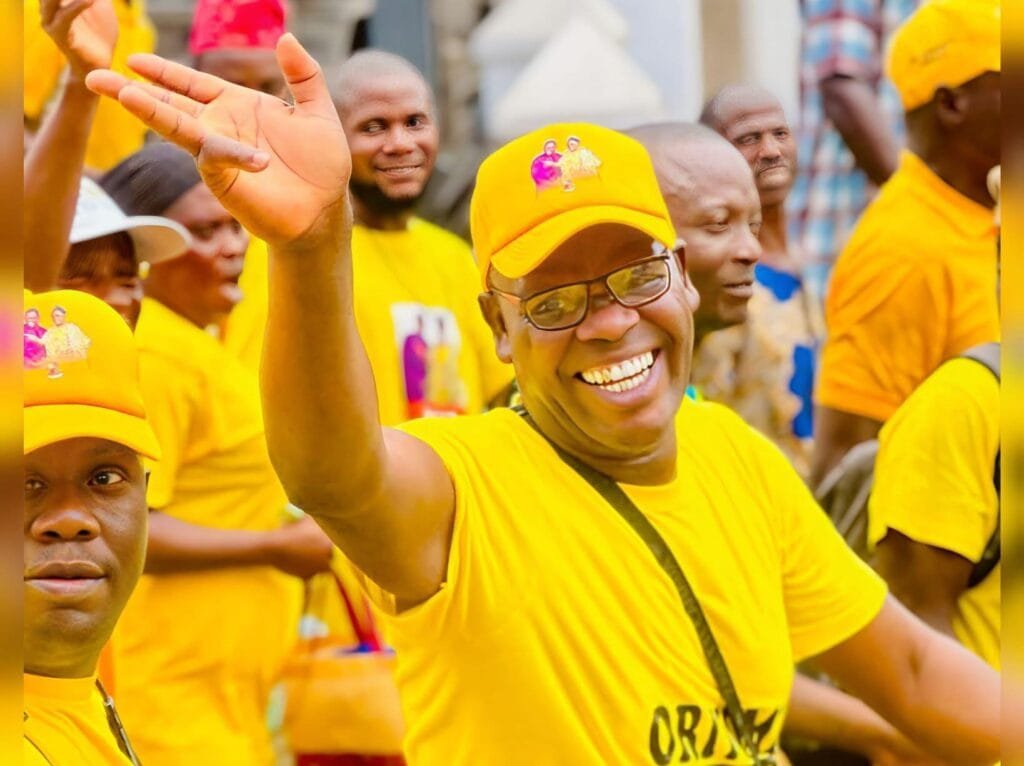
Ibadan, Nigeria — In a dramatic political moment that could reshape the landscape of southwestern Nigerian politics, popular human rights activist and broadcaster Abdur-Rahman Oriyomi Hamzat on Saturday formally declared his intention to contest the 2027 Oyo State governorship under the platform of the Accord Party, positioning himself as a direct challenge to the state’s entrenched political establishment.
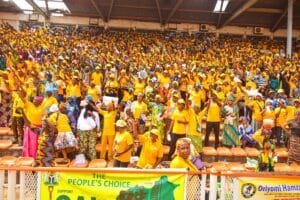
The declaration, held at Obafemi Awolowo Stadium, popularly called Liberty Stadium, in Ibadan, drew an estimated crowd of more than 25,000 people—an unusually large turnout for a non-incumbent, non-establishment figure this far ahead of an election cycle. The gathering was marked less by party elites than by everyday citizens: market women, artisans, youth volunteers, widows, orphans, and persons living with disabilities—many of whom credit Hamzat’s years of humanitarian intervention for their presence.
Hamzat, founder and chief executive of Agidigbo FM, is widely known across Oyo State and other part of southwestern Nigeria for leveraging his media platform to intervene in cases of injustice, raise emergency funds for the vulnerable, and mobilize rapid community responses to social crises. His announcement speech framed the 2027 race not as a conventional political contest but as what he called “a moral referendum on governance, dignity, and people-centered leadership.”
A Movement, Not a Machine
 Central to Hamzat’s political ambition is the Oyo N Pe O Movement, a loosely structured grassroots network that has evolved from volunteer-driven humanitarian work into a formidable civic mobilization force. Many in attendance identified themselves as volunteers rather than party loyalists, underscoring Hamzat’s claim that his candidacy is “powered by people, not political godfathers.”
“Our politics has become too distant from human suffering,” Hamzat told supporters. “This movement was born from the streets, from radio calls, from tears, and from hope. We are not here to negotiate with a broken system; we are here to replace it.”
Observers noted that the rally’s composition sharply contrasted with typical Nigerian political events dominated by party hierarchies and patronage networks. Instead, the Ibadan gathering resembled a mass civic assembly, blending faith leaders, disability advocates, and youth organizers into a single political statement.
Challenging the Status Quo
 By choosing the Accord Party, a smaller opposition platform, Hamzat appears intent on running against—not within—Nigeria’s dominant political structures. Analysts say the move carries both risk and symbolic weight in a country where third-party candidates often struggle against well-funded political machines.
Yet Hamzat’s media reach and reputation as a “solution broadcaster” may complicate traditional electoral calculations. His supporters argue that trust built through years of direct intervention—paying hospital bills, reuniting displaced families, and amplifying unheard voices—could translate into votes that defy conventional party arithmetic.
“This is not celebrity politics,” said one civil society observer at the rally. “It’s grievance politics—rooted in lived experience. That makes it unpredictable.”
The presence of defecting PDP leaders added a new political dimension to the gathering, transforming it from a symbolic declaration into what analysts describe as the early formation of a broad anti-establishment coalition. Several of the defectors cited frustration with internal party politics, alleged marginalization, and a disconnect between leadership and the grassroots as reasons for their exit.
“This movement represents the people we have failed to listen to for too long,” one former PDP chieftain said at the rally. “Politics must return to compassion, accountability, and service.”
National and International Attention
Hamzat’s declaration has already begun attracting attention beyond Oyo State, with diaspora groups and international media outlets monitoring the rise of a figure who blends activism, broadcasting, and populist politics in a region long shaped by political dynasties.
Whether the momentum seen in Ibadan can be sustained through the realities of party organization, fundraising, and electoral logistics remains an open question. But Saturday’s rally made one point unmistakably clear: a significant segment of the population is ready to test a new political formula—one anchored in social trust rather than traditional power.
As Nigeria edges toward the 2027 election cycle, Oyo State may now be shaping up as a bellwether for a broader question confronting democracies worldwide: can grassroots moral authority compete with entrenched political machinery—and win?
About The Author