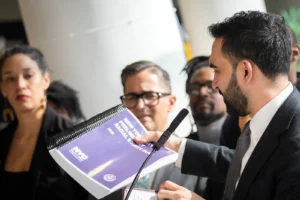
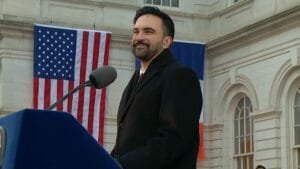
Editorial | Mamdani’s 100 Days: Conviction, Contradiction, and the Burden of Governing New York
Mamdani’s first 100 days show urgency and policy ambition, but also backlash over housing, homelessness, antisemitism, and whether he is governing as a true democratic socialist or a pragmatic progressive.
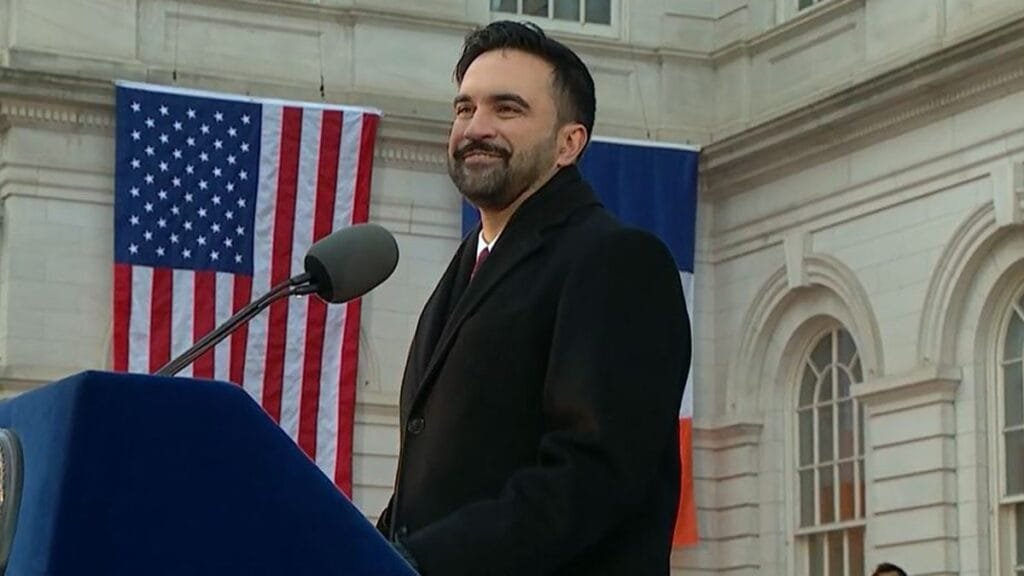
“You campaign in poetry. You govern in prose.” — Mario Cuomo
At New York Parrot, and in the neighborhood-facing reporting traditions of Bronx Post and Parkchester Times, we have long understood one basic truth about New York City governance: residents do not judge City Hall only by speeches, press releases, or ideological branding. They judge it by rent, by safety, by schools, by shelters, by business survival, by trust, and by whether government shows up in their lives as help or as confusion.
That is the proper frame for assessing Mayor Zohran Mamdani’s first 100 days.
A hundred days is not enough time to fully judge a mayor. It is enough, however, to understand his instincts, his governing language, and the kind of city he is trying to shape. On that measure, Mamdani’s opening chapter has been clear. He has governed with urgency, ideological confidence, and a visible concern for people who are often treated as an afterthought in municipal politics. He has also generated backlash on housing, homelessness, budgeting, and the politics of antisemitism. These first 100 days have not been empty. They have been active, revealing, and contested.
To his credit, Mamdani has not drifted into office. His administration tightened sanctuary protections through Executive Order 13, created a Mayor’s Office to Combat Antisemitism through Executive Order 02, formalized a 30-day deadline for releasing police body-camera footage after critical incidents, opened a Bellevue-based therapeutic housing unit for medically and psychiatrically vulnerable people in custody, and released two major planning documents: a preliminary racial equity plan and a city “true cost of living” measure showing that 62 percent of New Yorkers cannot meet the real cost of living in the city. Those actions reflect an administration trying to move policy closer to prevention, dignity, and structural repair rather than mere administrative maintenance.
Crime figures in the first quarter also gave the administration something real to stand on. City Hall and the NYPD announced the fewest murders and shooting incidents on record for the first three months of a year, with major crime down about 5 percent citywide and the Bronx posting one of the sharpest declines. Whatever one’s politics, fewer killings and fewer shootings matter. That is not messaging. That is relief. It matters in Midtown, in Brownsville, in Soundview, and in Parkchester alike. It matters to every parent who wants a child to get home safely.
But New York is not governed by momentum alone. It is governed by whether principles survive collision with budgets, agencies, courts, unions, neighborhoods, and the stubborn reality that not all good intentions can be funded, operationalized, or harmonized at once.
The first contradiction is housing. Mamdani campaigned in the language of affordability and tenant protection, yet his administration has already faced criticism for appealing a ruling that would have forced broader expansion of CityFHEPS housing vouchers. City Hall cited a worsening fiscal picture and long-term cost. That may be fiscally responsible; it is also politically costly. When an administration arrives promising relief and then retreats under pressure from budget reality, supporters notice. Our readers notice. And in boroughs where housing insecurity is not theoretical, such reversals land hard.
The second contradiction is homelessness. Associated Press, for instance, reported that Mamdani resumed homeless encampment sweeps after previously criticizing the practice. There may be practical reasons for that. Public order, winter exposure, and sanitation do not govern themselves. Still, the reversal tells us something important: campaign morality is cleaner than governing reality. A mayor can oppose a policy in theory and still discover that the city offers no simple substitute when confronted with the street-level consequences of inaction.
The third contradiction is tone. His public clash with the City Council over budget assumptions suggested that Mamdani can sometimes govern as though electoral victory is enough to settle internal disputes. It is not. A mayor in New York must persuade as well as pronounce. He must build coalitions, not merely sharpen distinctions. The city is too large, too layered, and too structurally stubborn to be governed by declaration alone.
Then there is the question many New Yorkers are still asking, especially after years of fear, polarization, and distrust: has Mamdani quenched antisemitism, or has he inflamed it?
The truthful answer, at 100 days, is neither simple vindication nor simple indictment. On one hand, Mamdani preserved and formalized a Mayor’s Office to Combat Antisemitism through Executive Order 02. The order established an interagency task force, directed the office to improve monitoring of antisemitic incidents, support victims, coordinate education efforts, and liaise with Jewish communities and law enforcement. In February, he appointed Phylisa Wisdom to lead that office. At a Passover event in late March, he acknowledged that “the rising tide of antisemitism has caused enormous pain for so many Jewish New Yorkers,” noting that synagogues that once felt like sanctuaries now require armed protection. Those are not the words of a mayor pretending the problem does not exist.
On the other hand, some of Mamdani’s early decisions intensified distrust among parts of the Jewish community and among pro-Israel voices. Reuters reported that he revoked executive orders from the Adams administration that had incorporated the IHRA definition of antisemitism and barred city institutions from divesting from Israel. Mamdani defended the decision by saying some Jewish groups had “immense concerns” about the IHRA definition, while pledging relentless opposition to antisemitism and greater support for hate-crime prevention. Yet critics argued that the move blurred an already contested line between anti-Jewish hatred and anti-Israel activism. That backlash is real and cannot be waved away.
So has he quenched antisemitism? Not yet. No mayor could claim that honestly in 100 days. Has he inflamed it? His critics say yes, especially through symbolism and long-known positions on Palestine. But the record also shows concrete administrative action against antisemitism. The fair conclusion is that Mamdani has not resolved the city’s antisemitism crisis, but neither has he governed as though it does not exist. He has acted institutionally while still carrying political baggage that leaves many Jewish New Yorkers unconvinced. That is not settled success. It is an unfinished test.
That leads naturally to the second ideological question: is Mamdani truly governing as a democratic socialist, or more as a pragmatic progressive operating within capitalist limits?
Again, the evidence points to a mixed answer. His agenda clearly carries democratic-socialist themes: free childcare expansion, a racial-equity planning framework, a new true-cost-of-living metric, stronger sanctuary protections, a community safety office designed in part to reduce overreliance on traditional policing, and public calls for higher taxes on millionaires and corporations. These are redistributive and state-activist instincts, not market-fundamentalist ones.
But his governing practice so far has been more constrained than doctrinaire. He has not broken with the city’s underlying private-market housing structure. He has defended budget caution when confronted with voucher costs. He has tolerated familiar enforcement tools, such as encampment sweeps, when reality pressed back. He has highlighted crime declines rather than dismissing conventional public safety metrics. In short, Mamdani is governing less like a revolutionary socialist and more like a left-progressive mayor trying to push a capitalist city toward greater public obligation, stronger social provision, and more explicit moral accountability. That may disappoint ideological purists. It may also be the only way such a mayor can govern New York at all.
Public opinion reflects this ambiguity. Marist found that 48 percent approve of Mamdani’s performance, 30 percent disapprove, and 23 percent are unsure. Those are respectable opening numbers, but they do not amount to broad ratification. They describe a city that is interested, cautious, and still deciding whether energy will mature into steadiness.
This is the central truth of Mamdani’s first 100 days. He has brought moral force, urgency, and policy motion. He has also revealed the familiar limits of insurgent governance: campaign promises meet fiscal walls, ideals meet institutional drag, and symbolic choices can deepen as well as heal mistrust.
From New York Parrot’s citywide vantage point, from Bronx Post’s ground-level reading of how policy lands in working neighborhoods, and from Parkchester Times’ feel for the everyday anxieties of ordinary residents, one lesson stands out: New Yorkers are less interested in ideological self-description than in administrative reliability. They want to know whether the trains of government are running in their direction. They want to know whether the mayor’s moral vocabulary can become durable public results.
That is where the city now stands. Not before a savior. Not before a failure. But before a mayor with conviction, visible momentum, and a narrowing margin for contradiction.
A hundred days can introduce a mayor. They cannot absolve him. They cannot canonize him. And they certainly cannot exempt him from the harder judgment still to come: whether he can govern New York in a way that is not only morally animated, but institutionally durable, socially unifying, and honest about both the promise and the limits of his politics.
Mutiu Olawuyi
Chief Editor, New York Parrot
About The Author