NYC reaches 100,000 pothole repairs as DOT accelerates response to Winter street damage
New York City says it has filled 100,000 potholes in the first 100 days of 2026, as DOT crews respond to winter street damage and prepare for broader resurfacing work.
New York City has reached 100,000 pothole repairs within the first 100 days of 2026, according to City Hall, marking the highest early-year total in more than a decade and underscoring the scale of street damage caused by a severe winter across the five boroughs.
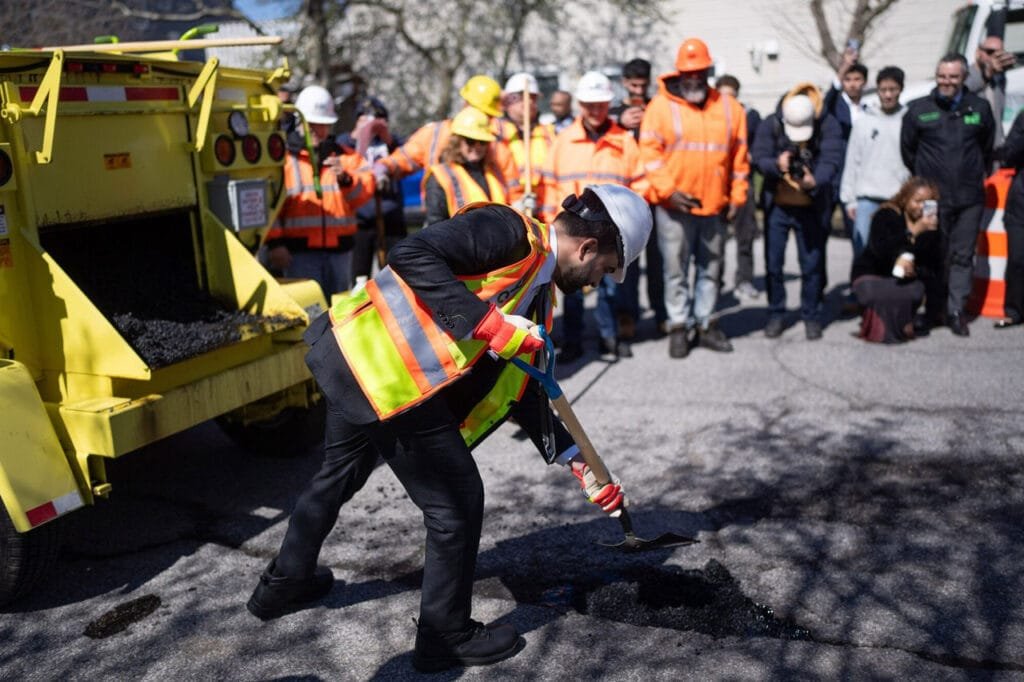
The milestone was marked on Olympia Boulevard in Staten Island, where Mayor Zohran Kwame Mamdani joined city officials to highlight the Department of Transportation’s response to deteriorating road conditions. City Hall said the repair pace is the fastest recorded for the opening 100 days of a year in 11 years.
Whatever the politics surrounding City Hall, potholes remain one of the most immediate and least ideological quality-of-life issues New Yorkers face. They affect bus service, emergency vehicles, delivery traffic, cyclists, drivers, and pedestrians alike. In that sense, the importance of the 100,000 figure lies less in ceremony and more in whether repairs are reaching neighborhoods quickly, fairly, and effectively.
In the words of the administration, the push followed what officials described as a brutal winter. Mayor Mamdani said, “For weeks, DOT crews have been out before sunrise, filling potholes and making our streets safer and more accessible.” He added that this is “the often-invisible work that keeps our city moving,” and said New Yorkers deserve “a government that not only hears their concerns, but delivers solutions big and small.”
According to City Hall, the Department of Transportation intensified repairs as warmer weather exposed winter damage more fully. Deputy Mayor for Operations Julia Kerson said, “As warm weather arrived and our streets began to thaw, our City was ready to address the wear-and-tear of a brutal winter.” She also praised DOT staff, saying she was “incredibly grateful to the workers of DOT who have worked efficiently and effectively to conduct blitz after blitz to repair our streets.”
The Department of Transportation organized three Saturday pothole blitzes in March, deploying 80 crews beginning at 6 a.m. during each operation. City figures show that workers filled 7,200 potholes on March 14, 8,000 on March 21, and 7,600 on March 28.
DOT Commissioner Mike Flynn framed the repairs as part of a broader infrastructure response. “This winter hit our streets hard — but NYC DOT hit back, filling more than 100,000 potholes across the five boroughs,” he said. Flynn added, “Now, we’re shifting into full-scale resurfacing to deliver the safe, smooth streets New Yorkers deserve.”
That next phase may prove even more important than the 100,000-pothole milestone itself. Filling potholes is essential, but resurfacing offers a longer-term solution. City Hall says NYC DOT plans to repave 1,150 lane miles this year, a distance the administration says would stretch from New York City to Miami. Through the spring, summer, and fall, crews that have focused on pothole repairs are expected to transition into that larger resurfacing program.
For residents, the real measure of success will not be the headline number alone, but whether streets become smoother, safer, and more reliable in everyday life. If the city can sustain both repair speed and repair quality, the effort may reduce vehicle damage, cut complaints, and improve mobility in neighborhoods where infrastructure problems often linger longest.
In a city where trust in government is often built through basic delivery rather than big promises, road maintenance remains one of the clearest tests of whether public service is meeting public need.
About The Author