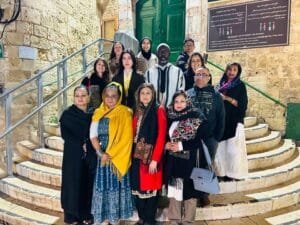
Holocaust Education Delegation Brings Muslim, Jewish and Arab Voices to Poland at Time of Global Fracture
Sharaka’s 2026 March of the Living Delegation will bring Muslim, Jewish and Arab public voices to Poland for Holocaust remembrance, interfaith dialogue and civic peacebuilding.
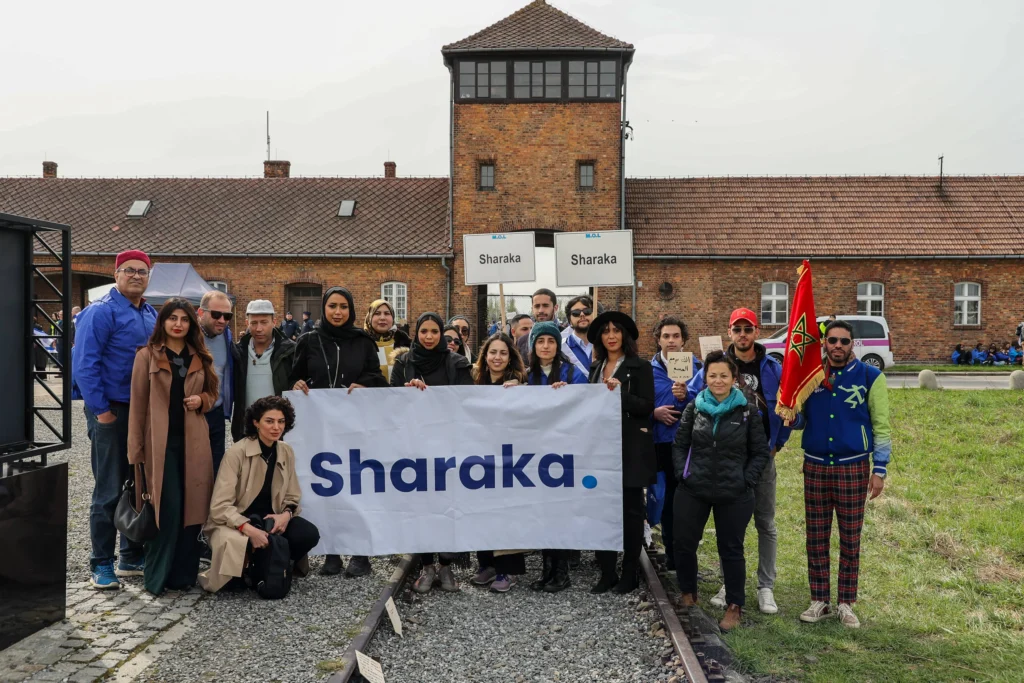
Sharaka’s 2026 March of the Living initiative places remembrance, interfaith diplomacy and moral witness at the centre of a growing international struggle over memory, identity and coexistence.
As war, polarization and identity-based conflict continue to reshape public life across regions, a diverse international delegation of Muslim, Jewish, Arab and Western civic voices is preparing to travel to Poland for one of the world’s most symbolically charged acts of historical remembrance: the March of the Living.
The 2026 Sharaka March of the Living Delegation, according to official program materials, will bring journalists, educators, interfaith leaders, media personalities, policy thinkers and peace advocates to sites associated with the Holocaust, including Auschwitz, Auschwitz-Birkenau, and Plaszow, in an effort to transform remembrance into a living ethic of civic responsibility and coexistence.
The initiative comes at a moment when memory itself has become contested terrain. Across Europe, the Middle East, Africa and North America, public debates over historical suffering, identity, antisemitism, Islamophobia, nationalism and moral solidarity have grown more volatile. In that context, the significance of this delegation lies not only in where it is going, but in who is going—and what they are expected to do with the experience after they return.
According to the organizer, participants are being invited not merely to observe history, but to engage in “meaningful dialogue that breaks down barriers, builds bridges, and strengthens the role of moderate voices in our societies.” The document also encourages delegates to share their reflections publicly, framing the journey as part of a broader effort to extend the lessons of the Holocaust beyond memorial spaces and into contemporary civic life.
Memory as Diplomacy
The delegation is organized by Sharaka, a platform dedicated to people-to-people diplomacy in the Middle East and to building communities through education and engagement around the Abraham Accords. Its partnership with the Conference on Jewish Material Claims Against Germany, widely known as the Claims Conference, places the trip within a broader architecture of Holocaust education, restitution, and postwar historical accountability.
That institutional framework is significant because, for decades, Holocaust remembrance has often been approached in educational or commemorative terms. But in the current global climate, it is increasingly being re-read through the lens of democratic resilience, interfaith ethics, and the politics of human recognition. Sharaka’s framing suggests an attempt to reposition Holocaust education not only as a Jewish historical imperative, but as a civic and moral challenge for plural societies more broadly.
In practical terms, the itinerary reflects that ambition. Delegates are expected to begin in Kraków, with a guided exploration of Kazimierz, the city’s historic Jewish quarter, before moving into visits to extermination and concentration camp sites, reflection sessions, and encounters with members of the local Jewish community. The structure is designed to juxtapose life before annihilation with the machinery of annihilation itself.
That sequencing matters. It resists a common tendency in Holocaust memory culture to reduce Jewish history to Jewish death. Instead, it begins with community, civilization and presence before confronting the violence that sought to erase them.
A Deliberately Unusual Delegation
The participant list reveals one of the program’s most consequential dimensions: it is not built around conventional diplomatic representation, but around public intermediaries—people whose work lies in shaping narrative, moral discourse and social trust.
Among the listed participants are Pakistani journalist Ahmed Quraishi; UAE- and Saudi-linked linguistics and peace advocate Loay Al Shareef; Moroccan cultural commentator Amine Drissi; Syrian-American broadcaster Hayvi Bouzzo; Israeli Bedouin educator Tamer Masudin; Moroccan, Azerbaijani, Pakistani-American, British Muslim and American public figures; and several actors involved in interfaith and educational work across regions.
Also included are Sheikh Musa Drammeh and Shireena Drammeh, two New York-based figures whose work has long intersected with interfaith education, civic bridge-building and community dialogue. Sheikh Musa Drammeh, according to Sharaka, as a community leader whose work spans faith, media and social action, while Shireena Drammeh is an educator and community builder with more than two decades of experience in youth development and interfaith engagement in the Bronx.
Their presence is notable not simply because of biography, but because it reflects the broader architecture of the delegation: this is a gathering of individuals who operate in the realm between institutions and publics. They are not passive attendees. They are interpreters, translators, and in some cases, ideological mediators.
Why This Matters Now
The deeper significance of the delegation lies in its timing. Holocaust remembrance, once treated as a moral consensus in much of the postwar world, now exists within a far more unstable political and discursive environment. Social media has accelerated both remembrance and distortion. Public empathy is increasingly fragmented by tribalism. And in many parts of the world, communities are being asked to confront one historical trauma while simultaneously negotiating their own unresolved wounds.
That makes the politics of memory more difficult—but also more urgent.
For an initiative such as this to have meaning, it must do more than affirm familiar slogans about “never again.” It must ask whether remembrance can still interrupt dehumanization in real time. It must ask whether people who encounter the moral wreckage of the Holocaust will return more capable of resisting hatred in all its contemporary forms—including antisemitism, anti-Muslim bigotry, ethnonational chauvinism, and civic indifference.
In that sense, the most important part of this delegation may not be the walk through Poland itself, but what follows afterward: the classrooms, media platforms, religious spaces, policy rooms and community conversations to which participants will return.
The Burden of Witness
There is a difference between visiting history and being altered by it.
The Sharaka delegation appears to be built around the hope that memory can still produce ethical seriousness in a time increasingly defined by spectacle, outrage and ideological simplification. Whether that hope holds will depend not on the symbolism of the trip alone, but on whether those who participate become more courageous in public life once they return.
That, ultimately, is the challenge of moral witness: not only to remember the dead, but to become more responsible for the living.
Reported and Edited by: Mutiu Olawuyi
About The Author