Birthright citizenship showdown reaches Supreme Court as New York leads constitutional fight
The U.S. Supreme Court heard arguments today in a major birthright citizenship case, as New York Attorney General Letitia James and allied states challenge President Trump’s executive order as unconstitutional.
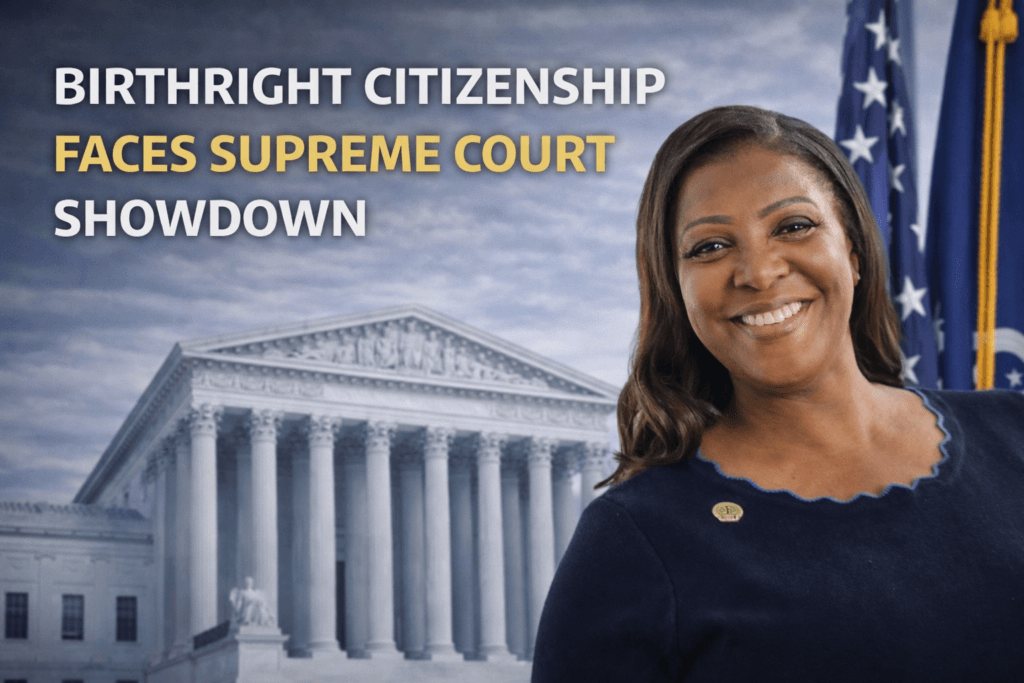
A major constitutional battle over birthright citizenship reached the United States Supreme Court today, as New York and a coalition of Democratic attorneys general pressed their case against what they describe as an unlawful executive order by President Donald Trump aimed at redefining who qualifies as an American citizen at birth.
At the center of the dispute is the administration’s effort to narrow the long-settled interpretation of the 14th Amendment, which has for more than a century guaranteed citizenship to nearly everyone born on U.S. soil. The challenge now before the high court has become one of the most consequential immigration and constitutional cases of the Trump presidency.
In a statement circulated as arguments were heard, New York Attorney General Letitia James said the coalition of attorneys general was proud to have led the legal fight against what she called an unconstitutional order. James argued that the president’s action violates the Constitution, federal statutes, and more than 150 years of settled legal practice. Her office has repeatedly maintained that a president cannot undo birthright citizenship through executive action.
The case has drawn national attention not only because of its sweeping implications for immigration and civil rights, but also because it could affect the legal status of hundreds of thousands of children born in the United States each year. Lower courts have consistently blocked the executive order from taking effect, with judges across multiple jurisdictions describing it as likely unconstitutional.
During oral arguments, several justices reportedly expressed skepticism toward the administration’s legal reasoning, including its interpretation of the constitutional phrase “subject to the jurisdiction thereof.” The administration has argued that the phrase excludes children born in the U.S. to undocumented immigrants or certain temporary visa holders. Opponents, however, say that position directly contradicts long-standing precedent, including the landmark 1898 Supreme Court ruling in United States v. Wong Kim Ark, which affirmed birthright citizenship under the 14th Amendment.
The case is about more than immigration policy. It is about whether a foundational constitutional guarantee can be narrowed by executive interpretation rather than democratic or judicial process. For immigrant families, civil rights advocates, and constitutional scholars, the stakes are deeply human as well as legal: access to identity, protection, belonging, and equal standing under the law.
For New York in particular, the case carries both legal and moral weight. As one of the country’s most immigrant-rich states, New York has framed the issue not only as a constitutional dispute but as a defense of social stability, public systems, and the idea that citizenship should not be determined by political whim. State officials have warned that any rollback could create administrative chaos, deepen family insecurity, and erode confidence in the legal guarantees that millions of Americans have long taken for granted.
A decision from the Supreme Court is expected later this year. Whatever the outcome, the case is likely to shape not just immigration law, but the future meaning of citizenship in the United States.
About The Author