Artemis II ignites new era of space exploration, Obama says
Former President Barack Obama praised NASA’s Artemis II mission as an inspiring return to lunar exploration, saying the first crewed Moon flight since 1972 could inspire a new generation of scientists, explorers, and dreamers.
By Mutiu Olawuyi
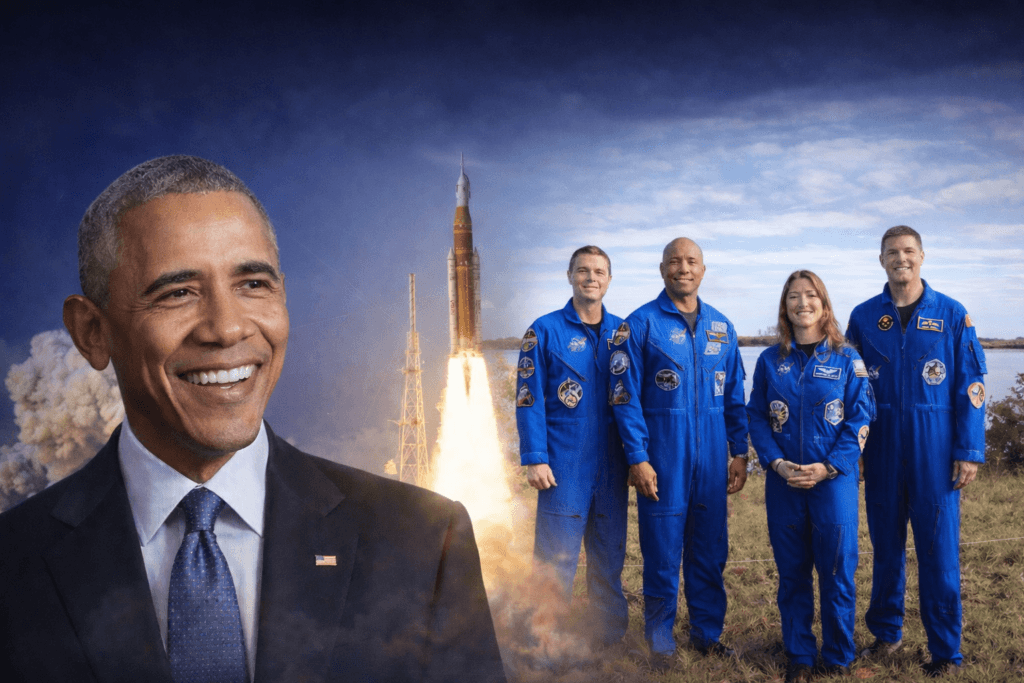
Former President Barack Obama has joined a growing chorus of voices celebrating NASA’s Artemis II mission, calling the historic launch an inspiring reminder of humanity’s ability to push beyond what once seemed impossible.
In a message posted on X, Obama praised the mission as NASA’s first crewed flight around the Moon since 1972, saying the U.S. space program has long represented an essential part of the nation’s spirit of exploration and ambition. He said he hoped the four astronauts aboard Artemis II would inspire a new generation to dream bigger, explore further, and pursue science and discovery with courage.
The mission, which launched successfully on April 1, 2026, marks the first time in more than five decades that humans have ventured beyond low Earth orbit toward the Moon. NASA says Artemis II is a critical step in its broader plan to return astronauts to the lunar surface and build the foundation for future missions to Mars. The roughly 10-day mission is carrying four astronauts aboard the Orion spacecraft on a lunar flyby designed to test deep-space systems, life-support technology, navigation, and crew performance.
The Artemis II crew includes Reid Wiseman, Victor Glover, Christina Koch, and Jeremy Hansen of Canada. The flight is already being recognized as historic beyond its technical significance: Glover is set to become the first Black astronaut to travel into deep space, Koch the first woman, and Hansen the first non-American to fly beyond low Earth orbit.
Obama’s reflection taps into something larger than nostalgia. For many Americans, the Artemis program represents a renewed belief in public science, long-term national vision, and the power of collective achievement. At a time when public discourse is often dominated by conflict and division, space exploration offers a rarer civic language — one rooted in curiosity, discipline, imagination, and shared human possibility.
Artemis II is not only about revisiting the Moon. It is about restoring confidence in what serious investment in education, science, engineering, and international cooperation can achieve. The mission also provides a symbolic bridge between generations: from the Apollo era that captivated the world to a new age of exploration that is more global, more inclusive, and more technologically ambitious.
For students, teachers, researchers, and young dreamers watching from classrooms and living rooms around the world, Artemis II may prove to be more than a mission. It may become a moment — one that reminds a new generation that the future is still something worth building.
About The Author